



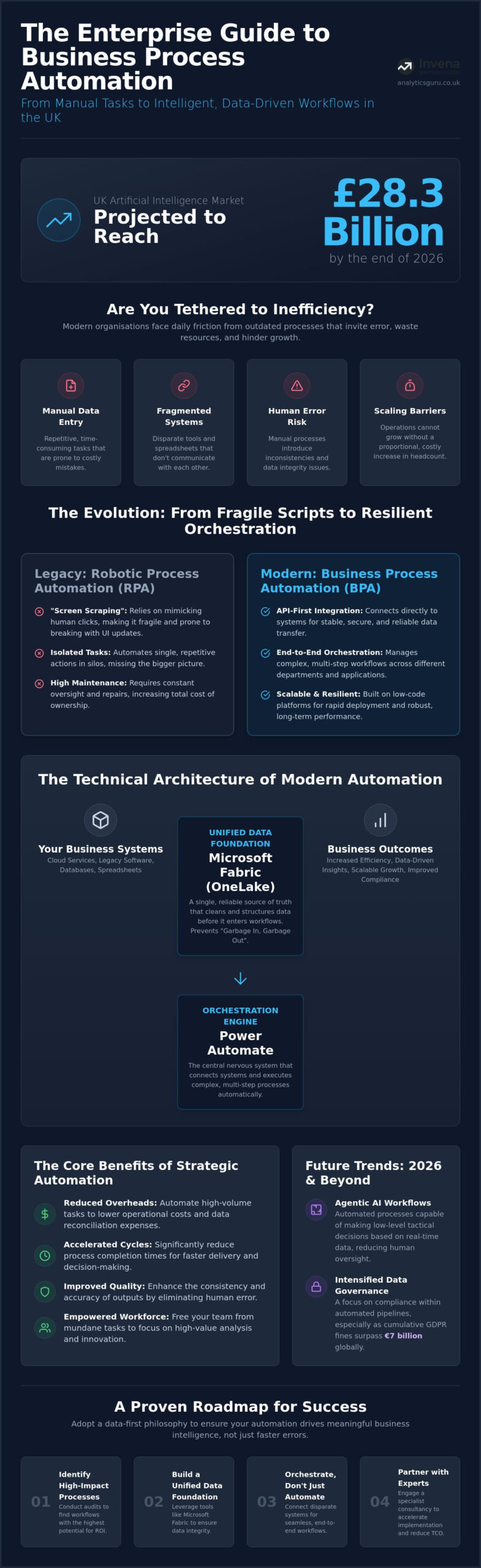
With the UK AI market projected to reach £28.3 billion by the end of 2026, why are so many enterprises still tethered to manual data entry and fragmented spreadsheets? Scaling a modern organisation requires more than just grit; it demands a shift toward intelligent, automated workflows. Implementing strategic business process automation UK wide is no longer a luxury for the forward-thinking; it’s a fundamental requirement for survival in an increasingly competitive landscape.
You likely recognise the daily friction caused by disparate systems that refuse to communicate, forcing your team to waste valuable hours on repetitive tasks that invite human error. We understand that the difficulty in scaling operations without a proportional increase in headcount remains a primary barrier to your long-term success. This guide will show you how to modernise these operations, eliminating manual errors whilst accelerating growth through a unified data architecture.
We will explore how leveraging the Microsoft ecosystem delivers measurable ROI and provides the real-time business intelligence needed to future-proof your processes. From reducing operational overheads to distilling complex data into actionable insights, you’ll discover the roadmap to true enterprise efficiency.
Key Takeaways
- Understand why UK enterprises are shifting from basic task automation to end-to-end strategic orchestration to combat rising operational costs.
- Learn how to leverage Power Automate and Microsoft Fabric to build a unified data foundation that ensures your workflows are reliable and scalable.
- Discover a proven roadmap for identifying high-impact processes and conducting audits that maximise your long-term return on investment.
- Analyse the strategic benefits of partnering with an expert consultancy for business process automation UK to reduce your total cost of ownership.
- Adopt a “Data-First” philosophy that prioritises data integrity, ensuring your automation drives meaningful business intelligence rather than simply moving errors faster.
Understanding Business Process Automation in the UK Landscape
Business process automation (BPA) represents the strategic deployment of technology to execute recurring tasks and complex workflows without human intervention. While many view it as a simple cost-cutting measure, it’s actually the architecture of modern enterprise agility. In the current economic climate, business process automation UK enterprises are adopting isn’t just about replacing manual data entry; it’s about building a resilient, scalable operation that thrives despite rising labour costs and market volatility.
The distinction between basic task automation and end-to-end orchestration is critical for any strategic guide. Many organisations start with Robotic Process Automation (RPA) to handle isolated, repetitive actions. However, true efficiency comes from workflow orchestration. This involves connecting disparate systems into a unified ecosystem where data flows seamlessly between departments. We’ve moved beyond siloed scripts; modern automation focuses on data-driven pipelines that ensure every automated action contributes to a larger strategic objective.
The Core Benefits of BPA for Enterprise Growth
Strategic automation reduces operational overheads whilst simultaneously elevating the quality and consistency of your outputs. By removing the human element from high-volume, low-complexity tasks, you eliminate the “hidden costs” of manual data reconciliation amongst departments. This doesn’t just save money; it improves employee satisfaction. Your team can focus on high-value analysis and creative problem-solving instead of being buried under tedious administrative burdens that stifle innovation. When you automate the mundane, you empower your workforce to drive growth.
Current Trends Shaping UK Automation in 2026
As we move through 2026, the landscape is shifting toward “Agentic AI.” These are automated workflows capable of making low-level tactical decisions based on real-time data, reducing the need for constant human oversight. There’s also an intensified focus on data governance and compliance within these automated pipelines, especially as cumulative GDPR fines have now surpassed €7 billion globally. Leading firms are now integrating these capabilities directly into their business intelligence consulting UK frameworks. This ensures that every automated step isn’t just efficient, but also generates the clean, structured data required for advanced analytics and long-term stability.
The Technical Architecture of Modern Automation
Modern automation isn’t a standalone tool; it’s an integrated layer within your enterprise stack. For many organisations, Power Automate serves as the central nervous system. It orchestrates everything. By adopting an API-first design, you ensure that even legacy on-premises systems can communicate with modern cloud services. This connectivity is vital for reaping the strategic benefits of automation, such as improved accuracy and significantly reduced cycle times.
A robust architecture requires a dedicated data engineering layer. Without it, you risk the “garbage in, garbage out” scenario where automated triggers react to inaccurate or outdated information. This is why business process automation UK leaders are prioritising integration over isolated scripts. By cleaning and structuring data before it enters the workflow, you ensure every automated decision is based on a single version of the truth.
Power Automate vs Traditional RPA
Legacy RPA often relies on “screen scraping,” which breaks the moment a user interface changes. It’s fragile. Modern cloud-native platforms like Power Automate use direct API integrations instead. This shift makes your workflows more stable and inherently more secure. Stability is the result. Because it’s a low-code environment, your team can deploy solutions faster without waiting for months of custom coding. If you rely on niche industry software, custom connectors bridge the gap. This ensures no part of your process remains siloed or manual.
Integrating Automation with Microsoft Fabric
Reliable automation requires a unified data foundation. Microsoft Fabric provides this through OneLake, acting as a single source of truth for all automated triggers. When your workflows ingest data in real-time, your organisation moves from reactive to proactive operations. For example, a shift in supply chain data within OneLake can automatically adjust logistics schedules without human intervention. Precision is non-negotiable. This synergy between data engineering and workflow optimisation is where true enterprise efficiency lives. If you’re looking to unify your own data architecture, exploring professional automation services can provide the technical expertise needed to connect these complex layers seamlessly.
Strategic Framework: Evaluating Your Automation Options
Selecting the right delivery model determines whether your automation efforts scale or stagnate. When evaluating business process automation UK enterprises must weigh the immediate cost of implementation against the long-term total cost of ownership (TCO). Off-the-shelf tools might offer a lower entry price, but they often lack the flexibility required to handle complex, bespoke business logic. Conversely, custom-built solutions provide total control but demand significant internal engineering resources to maintain and update as your requirements evolve.
Scalability is the silent killer of poorly planned automation. A workflow that functions perfectly for ten transactions a day might fail catastrophically when processing ten thousand. Ensuring your architecture remains robust as data volume grows is essential for maintaining momentum. Security and data residency are equally non-negotiable. With UK GDPR violations carrying potential fines of up to £17.5 million or 4% of worldwide annual turnover, whichever is higher, your automated pipelines must be designed with rigorous compliance and encryption at their core. Protecting sensitive information amongst fragmented systems requires a unified, governed approach.
The Build vs. Buy vs. Consult Dilemma
Internal IT teams are often best suited for simple, departmental task automation where the scope is limited and the risk is low. However, relying solely on internal resources for enterprise-wide transformation frequently leads to “Shadow IT.” This occurs when individual departments implement unmanaged automation tools that bypass central governance, creating security vulnerabilities and fragmented data silos. A strategic consulting partner bridges this gap. They provide the high-level expertise needed to align technical implementation with your broader business goals, ensuring long-term stability and performance without increasing your internal headcount proportionally.
Defining ROI Beyond Simple Time Savings
Measuring the success of your automation shouldn’t stop at hours saved. You must calculate the value of improved data accuracy and reduced compliance risk. Human error in manual data entry doesn’t just waste time; it leads to costly financial discrepancies and regulatory breaches. Consider the impact on your customer experience. Faster response times driven by automated workflows directly correlate with higher retention rates and increased revenue. To maintain transparency, we recommend using automated dashboards to track the performance of the automation itself, providing real-time visibility into your operational gains and ROI. Engaging specialist Power BI consulting services UK enterprises trust can ensure these dashboards are built on a scalable, governed data architecture that delivers accurate insights to your leadership team.
A Roadmap for Successful Automation Implementation
Moving from a strategic framework to a live environment requires a structured, phased methodology. Successful business process automation UK wide is never the result of a single “big bang” rollout. It’s a disciplined sequence of technical and operational milestones designed to minimise risk whilst maximising impact. By following a proven roadmap, you ensure that your automation efforts are grounded in reality and aligned with your broader commercial objectives.
Your journey begins with a thorough process audit. You must identify high-impact candidates where manual intervention currently creates the most significant friction. Once these are prioritised, the focus shifts to data cleansing. As established in our technical architecture discussion, your automation is only as reliable as the data it moves. Consolidating your sources at this stage prevents the propagation of errors through your new workflows. Following this, a Proof of Concept (PoC) allows you to demonstrate value in a controlled environment, securing the stakeholder buy-in needed for a wider rollout.
Scaling the solution requires a balance between speed and governance. You must expand your automated pipelines across departments whilst maintaining the strict security standards required for UK compliance. The final step is the implementation of managed support and continuous monitoring. This ensures your workflows remain optimised and adapt to system updates or changing business logic without interruption. If you’re looking for a partner to guide you through this transition, our automation services provide the end-to-end expertise required to deliver a seamless implementation.
Identifying the Right Processes to Automate
Adopting the “High Volume, Low Complexity” rule is the fastest way to secure early wins. These tasks are often the most prone to human error and offer the clearest path to immediate ROI. We recommend using process mining tools to discover bottlenecks that aren’t visible to the naked eye. Crucially, you must avoid the trap of automating an already broken or inefficient process. Automating a flawed workflow only results in faster inefficiency. You must refine the underlying logic before applying the technology.
Ensuring Long-Term Adoption through Training
Technical deployment is only 50% of the battle in any digital transformation programme. Cultural alignment and staff competency are the remaining half. Organising tailored workshops empowers your team to manage and even tweak their own workflows, fostering a sense of ownership rather than displacement. This is where managed support becomes essential. It provides a safety net that maintains workflow integrity during major system updates, ensuring that your automation remains a permanent asset rather than a temporary fix.
The Analytics Guru Approach to Business Process Automation
At Analytics Guru, we operate on a “Data-First” philosophy. We believe that automation is only as good as the data it moves. If your underlying data is fragmented or inaccurate, automation simply accelerates the propagation of errors across your organisation. By prioritising data integrity at the engineering level, we ensure that every workflow we deploy for business process automation UK clients is built on a foundation of absolute reliability. This commitment to precision is why we maintain a 99%+ customer retention rate across more than 100 projects completed for global enterprise organisations.
With 20 years of experience in the Microsoft ecosystem, we bridge the gap between complex backend engineering and the actionable business intelligence dashboards your leadership team requires. We don’t just build isolated scripts; we design end-to-end solutions using Power Automate, Microsoft Fabric, and Power BI. This holistic approach ensures that your automated processes aren’t just efficient, but also contribute directly to your strategic goals by providing real-time visibility into operational performance. Our proactive managed support ensures these systems remain stable as your business logic evolves.
End-to-End Data Transformation
Our work often begins with modernising legacy environments, such as migrating complex Excel-based processes into real-time automated reporting systems. We utilise PowerApps to create custom, user-friendly interfaces that allow your staff to interact with automated workflows without needing deep technical knowledge. Our unique methodology combines ETL automation with strategic BI to turn raw data into a high-impact competitive advantage. This transformation distills complexity into clarity, allowing your organisation to scale without the traditional friction of manual data management.
Partnering for Sustainable Growth
We view ourselves as a strategic guide rather than a mere service provider. A significant part of our value lies in knowledge transfer; we don’t just build your systems, we enable your team to manage and evolve them. This ensures long-term adoption and prevents the technical debt often associated with outsourced IT projects. Our national UK presence allows us to offer high-level enterprise consulting and proactive managed support that keeps your operations running smoothly as you grow. Ready to eliminate manual bottlenecks? Speak with an Analytics Guru consultant today to start your journey toward true operational efficiency.
Future-Proofing Your Operations Through Intelligent Automation
Transitioning from manual, error-prone workflows to a unified digital architecture is no longer a choice; it’s a strategic necessity. You’ve seen how integrating Power Automate with Microsoft Fabric creates a reliable foundation for growth whilst reducing the total cost of ownership. By following a structured roadmap and prioritising data integrity, your organisation can finally decouple headcount growth from operational scale.
Implementing business process automation UK wide requires a steady hand and deep technical expertise. With over 20 years of BI and automation experience, Analytics Guru has delivered over 100 successful projects for global enterprises, maintaining a 99%+ customer retention rate. We bridge the gap between complex engineering and the real-time insights you need to lead with confidence.
Optimise your operations with a strategic automation audit from Analytics Guru. Your journey toward seamless efficiency starts with a single, data-driven step. We look forward to helping you unlock your full potential.
Frequently Asked Questions
What is the difference between Business Process Automation and Robotic Process Automation?
Robotic Process Automation (RPA) typically handles specific, repetitive tasks by mimicking human interactions with software, such as screen scraping or basic data entry. In contrast, Business Process Automation (BPA) is a broader strategy that orchestrates end-to-end workflows across multiple systems and departments. While RPA solves individual task inefficiencies, BPA restructures the entire process to ensure seamless data flow and long-term strategic alignment.
How much does it cost to implement business process automation in a UK enterprise?
Total investment for business process automation UK wide depends on the complexity of your existing data architecture and the scale of required integrations. You must account for software licensing fees, such as Microsoft 365 subscriptions, alongside professional consultancy costs for the audit, engineering, and testing phases. Most enterprises find that the reduction in operational overheads and human error provides a clear path to recouping these costs within the first year.
How long does a typical automation project take from audit to deployment?
A standard enterprise project moves from the initial audit phase to full deployment within 8 to 16 weeks. We recommend a phased approach where a Proof of Concept (PoC) is delivered within the first month to demonstrate immediate value to stakeholders. This timeline ensures sufficient time for data cleansing, custom connector development, and staff training, which are essential for maintaining workflow integrity and long-term stability.
Can business process automation integrate with our existing legacy software?
Modern automation platforms integrate with legacy software through robust APIs or custom-built connectors. If your legacy system lacks a modern interface, bridge technologies and data engineering layers can ensure data flows securely between on-premises databases and cloud environments. This connectivity allows you to modernise your operations and eliminate manual bottlenecks without the need for immediate, high-cost hardware replacements or total system overhauls.
What are the main security risks associated with automated workflows?
The primary risks involve unauthorised data access and fragmented governance, which can lead to “Shadow IT” vulnerabilities if departments implement unmanaged tools. Automated workflows must be designed with rigorous encryption and role-based access controls to maintain strict UK GDPR compliance. Centralised monitoring is essential to ensure that sensitive information remains protected as it moves amongst different departmental systems and cloud services.
How do we measure the ROI of our automation investment?
You measure ROI by tracking the reduction in manual labour hours and the elimination of financial discrepancies caused by human error. Additionally, faster cycle times and improved data accuracy contribute directly to customer retention and revenue growth. We recommend utilising automated Power BI dashboards to monitor these performance metrics in real-time, providing your leadership team with a transparent view of tangible operational gains.
Is Power Automate the best tool for UK businesses using Microsoft 365?
Power Automate is the most efficient choice for organisations already operating within the Microsoft 365 ecosystem. Its native integration with Excel, SharePoint, and Teams allows for seamless workflow orchestration without the need for expensive third-party middleware. This synergy reduces implementation friction and ensures that your business process automation UK strategy remains fully compatible with future Microsoft updates and security patches.
Do we need to hire new staff to manage our automated processes?
You don’t need to increase your headcount to manage automated processes. The core purpose of automation is to empower your existing team by removing tedious administrative burdens, allowing them to focus on high-value strategic tasks. Partnering with a consultancy for managed support and training ensures that your technical architecture remains optimised and stable without requiring you to recruit dedicated internal automation engineers.