



Most UK enterprises are currently sitting on a data liability rather than a strategic asset. Whilst your organisation likely collects vast amounts of information, fragmented silos and legacy on-premises infrastructure often turn that potential into a bottleneck. Deploying Azure data engineering services isn’t simply a technical migration; it’s a fundamental shift that converts sluggish reporting and security concerns into a streamlined, scalable engine for growth.
You’ve likely felt the frustration of waiting days for critical business reports or worrying about how UK GDPR compliance fits into a cloud-first world. We agree that the path to a single version of the truth often feels unnecessarily complex. This guide promises to clarify the Azure data toolkit, specifically the transition to the unified Microsoft Fabric platform, whilst providing a clear roadmap for building a resilient architecture. You’ll gain the technical insight and strategic confidence needed to select a partner who can turn your fragmented data into your most powerful competitive advantage.
Key Takeaways
- Learn how to transform fragmented data into a high-performance asset by understanding the foundational role of the data engineer.
- Discover the essential toolkit within Azure data engineering services and how these components interact to power your organisation’s analytics.
- Identify the most effective architecture for your business by comparing traditional data warehouses with modern, scalable lakehouse patterns.
- Establish robust security and cost-management protocols to ensure your data infrastructure remains compliant and financially predictable.
- Prepare for the next generation of analytics by exploring the strategic benefits of transitioning to the unified Microsoft Fabric platform.
What are Azure Data Engineering Services?
Data engineering is the invisible architecture that supports every high-performing business. Within the Microsoft ecosystem, Azure data engineering services represent the comprehensive suite of tools used to ingest, clean, and structure information within the cloud. Whilst many stakeholders focus on the final dashboard or AI output, the real value is created in the “plumbing” designed by data engineers. They ensure that information flows reliably from your CRM, ERP, and external APIs into a unified environment where it can actually be used.
Moving from legacy on-premises servers to Azure is a strategic move that many UK firms are prioritising this year. Legacy systems often create bottlenecks, where processing a single monthly report takes days of manual effort. In contrast, cloud engineering allows for the distillation of raw, messy data into refined, actionable insights. It’s the difference between having a warehouse full of unlabelled boxes and a high-speed, automated distribution centre where every item is indexed and ready for immediate dispatch.
The Core Objectives of Data Engineering
The primary goal is to eliminate the “garbage in, garbage out” problem that plagues many analytics projects. By implementing Data engineering best practices, organisations achieve three critical goals:
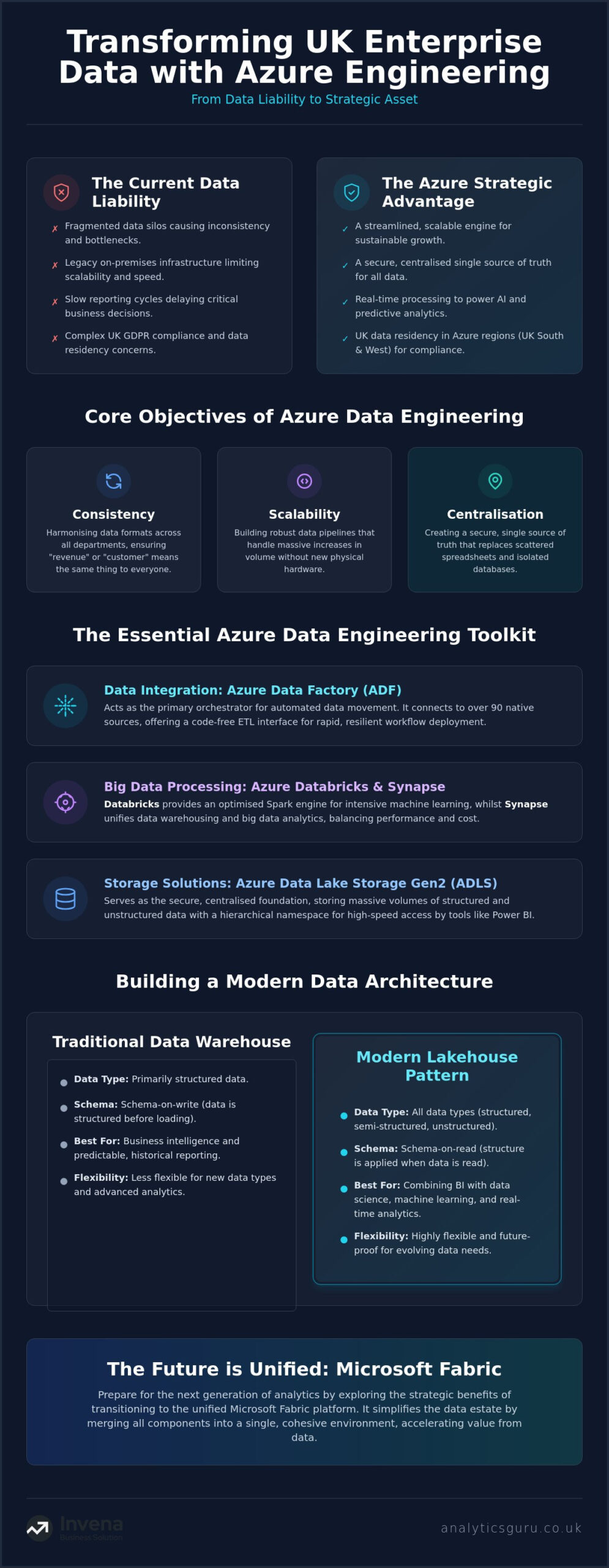
- Consistency: Harmonising data formats across different departments so “revenue” or “customer” means the same thing to everyone.
- Scalability: Building pipelines that can handle a massive increase in volume without crashing or requiring new physical hardware.
- Centralisation: Creating a secure, single source of truth that replaces scattered spreadsheets and isolated databases.
Why Cloud Engineering Matters in 2026
The landscape in 2026 demands more than just historical reporting. Enterprises now require real-time processing to feed AI models and predictive analytics engines. Robust Azure data engineering services provide the necessary foundation for these advanced capabilities, ensuring that your AI initiatives are built on high-quality, reliable data. For UK-based companies, this transition also addresses critical sovereignty concerns. By leveraging Azure regions like UK South and UK West, businesses can ensure their data residency remains compliant with local regulations whilst benefiting from the global scale and speed of the cloud. This foundation isn’t just a technical requirement; it’s the prerequisite for any organisation aiming to scale efficiently in a data-driven economy.
The Essential Azure Data Engineering Toolkit
Modern data stacks aren’t built as monolithic blocks; they’re modular ecosystems designed for agility. Selecting the right combination of Azure data engineering services ensures that your architecture remains flexible whilst avoiding the technical debt associated with poorly integrated tools. By focusing on a best-of-breed configuration, you can move data from disparate sources to high-impact dashboards with minimal latency and maximum reliability.
Data Integration: Azure Data Factory (ADF)
Azure Data Factory acts as the primary orchestrator, connecting over 90 native sources to move information across your cloud environment. It offers a code-free ETL (Extract, Transform, Load) interface that allows teams to deploy complex workflows rapidly. Azure Data Factory is the backbone of automated data movement, ensuring that every pipeline triggers precisely and handles errors with industrial-grade resilience.
Big Data Processing: Azure Databricks and Synapse
High-performance analytics requires specialised processing power tailored to the workload. Azure Databricks leverages an optimised Spark-based engine to handle intensive machine learning tasks and complex data transformations at significant scale. In contrast, Azure Synapse Analytics provides a unified platform that merges enterprise data warehousing with big data processing. Organisations can choose between serverless SQL pools for ad-hoc exploration or dedicated resources for predictable, high-volume workloads. This flexibility allows you to balance raw performance with strict budgetary control without compromising on speed.
Storage Solutions: Azure Data Lake Storage Gen2
Azure Data Lake Storage Gen2 (ADLS Gen2) serves as the secure foundation for your data architecture. It stores massive volumes of both structured and unstructured data using a hierarchical namespace that organises files for high-speed access. This structure allows the platform to integrate effortlessly with downstream tools like Power BI, enabling real-time dashboards that reflect the latest business activity. By utilising ADLS Gen2, you create a centralised repository that is both highly secure and accessible to every tool in your stack.
Choosing the correct configuration amongst these powerful tools is where many organisations face their biggest challenges. Our data engineering and fabric services help you navigate these choices, ensuring your toolkit is built for long-term growth rather than short-term convenience. Selecting a tailored configuration ensures your Azure data engineering services deliver maximum value with minimal friction.
Building a Modern Data Architecture: Lakehouse vs. Warehouse
Choosing the right structural foundation is the most consequential decision in any data transformation project. Historically, UK enterprises relied on rigid data warehouses that, whilst performant, often struggled with the sheer volume and variety of modern information. Today, the conversation has shifted toward the data lakehouse, a hybrid model that combines the structured reliability of a warehouse with the low-cost scalability of a data lake. By utilising Azure data engineering services, organisations can implement a Medallion Architecture, which organises data into three distinct layers:
- Bronze: The landing zone for raw, unedited data exactly as it arrives from the source systems.
- Silver: A filtered and joined layer where data is cleansed, standardised, and enriched for cross-departmental use.
- Gold: The business-ready layer, highly optimised for high-speed reporting and final analytical consumption.
This tiered approach ensures data integrity whilst allowing data scientists to perform rapid, exploratory analysis in the earlier zones without disrupting production reports. It provides the “steady hand” needed to manage complex environments whilst maintaining the agility required for innovation.
The Rise of the Data Lakehouse
The lakehouse pattern has become the industry standard because it solves the “split-brain” problem of maintaining two separate systems for Business Intelligence and Artificial Intelligence. By leveraging Delta Lake technology, Azure brings ACID (Atomicity, Consistency, Isolation, Durability) transactions to big data workloads. This means you get the reliability usually reserved for SQL databases on top of your massive data lake files. For UK enterprises aiming for rapid growth, this architecture eliminates the need for expensive, redundant data movement, reducing both operational costs and the time-to-insight for critical business decisions.
Selecting the Right Framework for Your Business
Selecting between a pure warehouse, a data lake, or a unified lakehouse depends on your specific data volume, the velocity of incoming information, and the technical expertise of your team. The strategic move towards Microsoft’s “OneLake” concept further simplifies this by providing a single, unified storage layer for the entire organisation. However, without rigorous standards, a data lake can quickly descend into a “data swamp” where information is stored but never found. Expert business intelligence consulting UK is essential to define these organisational standards early, ensuring your Azure data engineering services build a scalable asset rather than a management headache. This structural clarity allows your team to focus on extracting value rather than fighting with fragmented infrastructure.
Implementation Best Practices: Security, Cost, and Governance
Deploying a sophisticated architecture is only the first step. The long-term success of Azure data engineering services depends on your ability to control operational costs and maintain a rigorous security posture. Without a strategic approach to governance, even the most advanced cloud environment can become a financial burden or a compliance risk. Shifting from a project-based mindset to an operational excellence model ensures your data platform remains an asset rather than a liability.
Cost Management and Optimisation
The most common objection to cloud migration is the fear of unpredictable “bill shock.” Managing cloud consumption requires more than just looking at a monthly invoice; it demands active monitoring through Azure Cost Management. By setting granular budget alerts and automated spending limits, you can prevent runaway processes from exhausting your resources. Right-sizing is equally critical. We often find that organisations over-provision their Dedicated SQL Pools or Databricks clusters. Adjusting these resources to match actual workload requirements can significantly reduce monthly expenditure without impacting performance. Automation plays a vital role here, as you can schedule pipelines to turn off idle compute resources during off-peak hours, ensuring you only pay for the processing power you actually consume.
Data Security and Compliance in the UK
For UK enterprises, data residency and sovereignty are non-negotiable. Your Azure environment must be configured to align with GDPR and specific industry regulations, such as those set by the FCA or NHS. We recommend implementing Managed Identities to eliminate the need for hard-coded credentials within your pipelines. Coupling this with Azure Key Vault ensures that all secrets and connection strings are stored in a highly secure, centralised location. Robust data protection requires the mandatory implementation of encryption for all information both at rest within storage accounts and in transit across the network. This multi-layered security approach protects sensitive enterprise data whilst maintaining the transparency required for regulatory audits.
Governance acts as the guardian of your data quality. It involves defining clear ownership, metadata standards, and lifecycle policies that prevent your environment from becoming unmanageable. A major part of this process involves reducing data migration risks by validating data integrity at every stage of the transition. If you are ready to secure your infrastructure whilst driving efficiency, our Data Engineering & Fabric Services provide the expert oversight needed to manage these complexities. Establishing these best practices early creates a stable foundation for the next phase of your digital transformation.
The Future of Azure Engineering: Transitioning to Microsoft Fabric
The landscape of cloud analytics is undergoing its most significant transformation in a decade. Whilst the individual tools discussed earlier remain powerful, the industry is rapidly consolidating towards a unified, SaaS-like experience. Microsoft Fabric represents this shift, moving away from the complex integration of separate components and towards a singular, AI-powered environment. For organisations currently managing various Azure data engineering services, this transition offers a path to reduce technical complexity whilst accelerating the delivery of business value.
Why Fabric is a Game-Changer
Fabric eliminates the traditional “integration tax” by providing a single, cohesive platform that handles everything from data ingestion to advanced AI modelling. You no longer need to stitch together disparate services or manage multiple security models across different environments. Instead, everything resides within “OneLake,” a unified storage layer that acts as the single source of truth for your entire organisation. This architecture allows for seamless integration with Power BI consulting services UK, enabling your team to generate insights the moment data arrives. It simplifies the user experience for both your engineering lab and the boardroom, ensuring that everyone works from the same high-performance asset without the friction of data movement.
Next Steps for Your Data Transformation
Adopting Microsoft Fabric data engineering today isn’t just about following a trend; it’s about future-proofing your organisation against the inefficiencies of fragmented legacy systems. However, the path to a unified platform requires a steady hand and a clear strategy. We recommend starting with a comprehensive readiness assessment to evaluate your current architecture and identify the most efficient migration path that minimises operational downtime.
Analytics Guru acts as your strategic partner throughout this journey. With over 20 years of experience and more than 100 completed projects, we understand how to navigate the technical hurdles of Azure data engineering services whilst keeping a firm focus on your long-term growth. Whether you need end-to-end implementation or managed support to ensure long-term adoption, our team provides the practical expertise needed to deliver straightforward results. Contact Analytics Guru today to request a bespoke data engineering roadmap and turn your complex data problems into manageable, high-impact solutions.
Accelerating Your Path to Data-Driven Growth
Transforming your organisation’s data from a fragmented liability into a high-performance asset is no longer a technical luxury; it’s a strategic necessity. By implementing modern Azure data engineering services, UK enterprises can dismantle silos and establish a single version of the truth that scales alongside their ambitions. Whether you are adopting a Medallion Architecture or transitioning to the unified power of Microsoft Fabric, the goal remains the same: driving smarter decisions through clear, actionable insights.
Success in this landscape requires more than just the right tools; it demands a partner who understands the nuances of UK compliance and the practicalities of cost optimisation. Analytics Guru brings over 20 years of data engineering expertise and a 99%+ customer retention rate to every project. As a strategic UK-based consultancy, we provide the steady hand needed to navigate technical complexity whilst prioritising your long-term stability and performance.
Book a Strategic Data Consultation with Analytics Guru today to define your bespoke roadmap. Your journey toward a more efficient, scalable, and profitable future starts with a solid data foundation. We look forward to helping you unlock the full potential of your enterprise information.
Frequently Asked Questions
What is the difference between a data engineer and a data scientist?
A data engineer focuses on the foundational architecture, building the pipelines that collect, clean, and structure raw information. In contrast, a data scientist uses that refined data to perform advanced statistical analysis and predictive modelling. One builds the engine whilst the other drives it to extract business value. Both roles are essential, but the engineer’s work must come first to ensure data quality and reliability.
How much do Azure data engineering services typically cost for a UK business?
Costs for Azure data engineering services depend entirely on your organisation’s data volume and processing frequency. Azure operates a consumption-based model; for instance, Azure Data Factory orchestration starts at approximately $1 per 1,000 runs, whilst serverless SQL pools in Synapse cost $5 per TB processed as of July 2026. We recommend utilising the Azure Pricing Calculator to forecast monthly expenditure based on your specific workload requirements and residency needs.
Is Microsoft Azure secure enough for sensitive financial or medical data?
Microsoft Azure provides industrial-grade security that meets the stringent requirements of the UK’s financial and healthcare sectors. It complies with global standards like HIPAA and local regulations such as GDPR. By utilising UK-specific data centres in London and Cardiff, organisations maintain data sovereignty whilst benefiting from advanced features like double encryption at rest and automated threat detection to protect sensitive enterprise information.
How long does a typical Azure data migration project take to complete?
A typical migration project usually spans between three to nine months depending on the complexity of your legacy environment. The process begins with a detailed assessment and proof of concept, followed by the actual data movement and validation phases. Smaller, well-defined migrations can be completed much faster, whilst enterprise-wide transformations require a phased approach to ensure business continuity and reduce operational risk.
Can I integrate my existing on-premises SQL databases with Azure?
You can absolutely integrate existing on-premises SQL databases with the cloud using a hybrid architecture. Tools like the Self-hosted Integration Runtime allow Azure Data Factory to securely access and move data from your local servers without exposing your internal network to the public internet. This enables a gradual transition where you can leverage cloud-scale analytics whilst keeping certain sensitive workloads on-premises if required.
What are the main benefits of using Azure Data Factory over other ETL tools?
Azure Data Factory excels due to its native integration with the broader Microsoft ecosystem and its ability to connect to over 90 different data sources. Unlike traditional ETL tools that require significant infrastructure management, Data Factory is a serverless, pay-as-you-go service that scales automatically. It provides a visual, code-free interface that accelerates development time, allowing your team to focus on logic rather than maintaining hardware.
Do I need to move everything to the cloud at once, or can I use a hybrid model?
Most UK organisations successfully adopt a hybrid model rather than moving everything to the cloud in a single migration. This phased approach allows you to move non-critical workloads first to validate your architecture and build internal confidence. A hybrid strategy ensures you can maintain legacy systems whilst slowly decommissioning on-premises hardware as your cloud-based Azure data engineering services become fully operational.
How does Microsoft Fabric differ from traditional Azure data services?
Microsoft Fabric is a unified SaaS platform that integrates previously separate services like Data Factory and Synapse into a single environment. Traditional Azure services are PaaS-based, requiring you to manage and link individual components yourself. Fabric simplifies this by using “OneLake,” a centralised storage layer that eliminates data duplication and provides a more streamlined experience for both engineers and business analysts.