



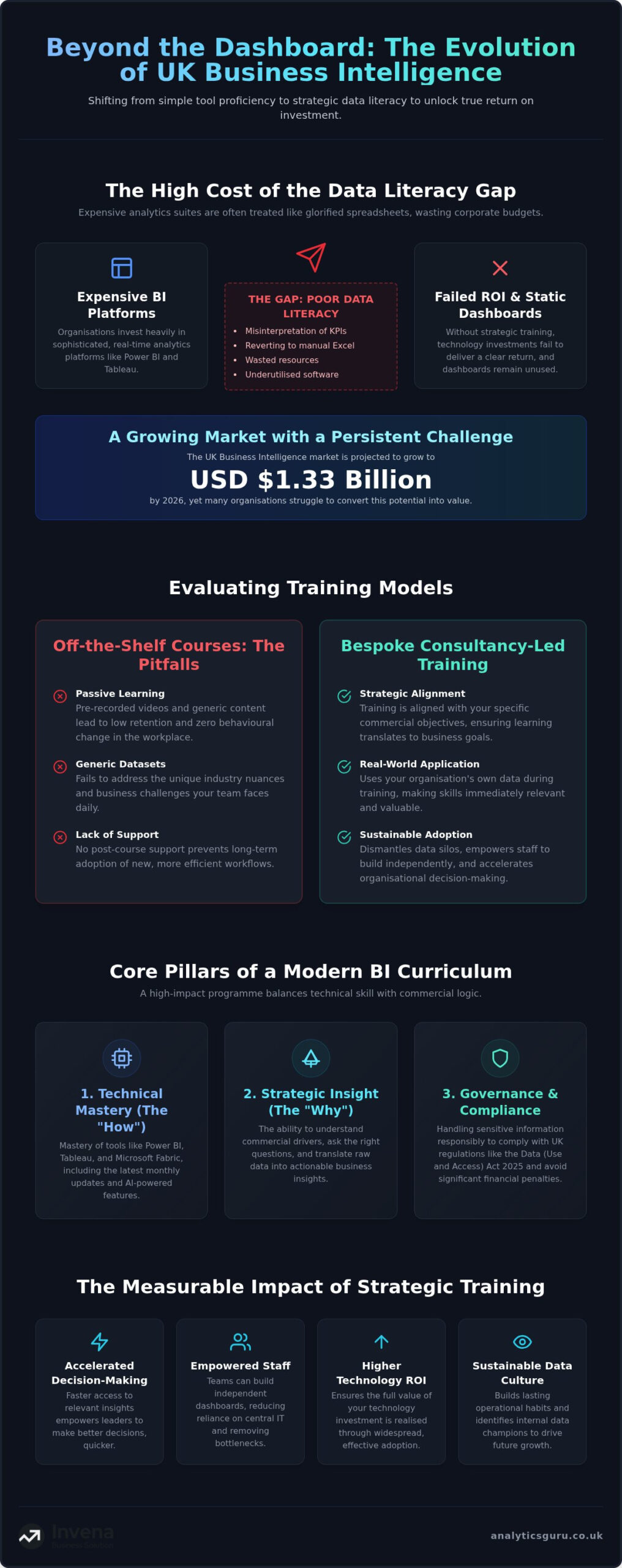
The most significant waste of a corporate budget isn’t a failed software rollout; it’s a team that treats a world-class analytics suite like a glorified spreadsheet viewer. Whilst the UK BI market is projected to grow to USD 1.33 billion in 2026, many organisations find that their expensive dashboards remain static because initial training failed to address the underlying strategy. You likely recognise the frustration of seeing teams rely on manual Excel work and fragmented workarounds despite having access to sophisticated, real-time platforms.
Strategic business intelligence training UK shifts the focus from simple tool proficiency to enterprise-wide data literacy. This guide demonstrates how to align technical skills with your specific business goals, ensuring that learning translates into long-term operational habits. We will explore how to dismantle data silos and empower your staff to build independent dashboards, resulting in a measurable improvement in your organisation’s decision-making speed and a higher return on your technology investment.
Key Takeaways
- Learn why UK enterprises are shifting from technical “tick-box” exercises to treating data literacy as a high-level strategic asset.
- Identify the core pillars of a modern curriculum that balances technical mastery in Power BI or Tableau with the ability to extract actionable insights.
- Evaluate the advantages of bespoke business intelligence training UK over generic courses to ensure new skills integrate seamlessly into daily operations.
- Discover how to build a sustainable roadmap by identifying internal data champions and aligning training with your broader commercial objectives.
- Understand the impact of consultancy-led training in dismantling data silos and accelerating organisational decision-making speed.
Beyond Tool Proficiency: The Evolution of Business Intelligence Training in the UK
Modern Business intelligence (BI) isn’t a static technical skill; it’s a strategic asset that drives enterprise growth and efficiency. For many UK enterprises, the focus has shifted from merely ticking a box to building a comprehensive data-driven culture. This evolution is necessary because tool proficiency alone doesn’t solve complex business problems. High-quality business intelligence training UK providers now focus on outcome-oriented learning that bridges the gap between raw data and actionable commercial insights.
The year 2026 marks a definitive turning point for the industry. Leading organisations have moved beyond basic reporting to integrate AI-powered assistants and natural language queries into their everyday workflows. Training that ignores these advancements leaves teams behind and creates friction. Effective sessions must now teach staff how to leverage these automated tools whilst maintaining a critical eye on the underlying logic. This ensures that technology serves the strategy rather than dictating it.
The High Cost of the Data Literacy Gap
Poor data literacy often results in the misinterpretation of key performance indicators (KPIs). When teams don’t understand the context behind the numbers, they waste resources on the wrong priorities or chase ghost trends. This creates a significant psychological barrier. Employees often revert to manual Excel work because it feels safer than using advanced BI tools they don’t fully trust. Data literacy is the ability to read, work with, analyse, and argue with data. Without this foundation, even the most expensive software remains underutilised and fails to deliver a clear return on investment.
Why Traditional Training Models are Falling Short
One-size-fits-all curricula typically fail because they ignore specific industry nuances and unique organisational structures. Passive learning, such as watching pre-recorded videos, leads to low retention and zero behavioural change in the workplace. Teams need more than a demonstration; they need to solve their own problems in real-time. Learning is most effective when it uses the organisation’s own data during the training process. This practical approach ensures that the skills stick and provides immediate value to the business. Traditional models often miss these critical elements:
- Passive learning lacks real-world application and fails to engage staff meaningfully.
- Generic datasets don’t address the unique business challenges your team faces daily.
- Lack of post-course support prevents the long-term adoption of new, efficient workflows.
Core Pillars of a Modern BI Curriculum: Technical Mastery and Strategic Insight
A high-impact curriculum balances technical execution with commercial logic. business intelligence training UK often fails when it treats these two elements as separate entities. In reality, a dashboard is only as good as the questions it answers. Developers must master the technical nuances of Power BI, Tableau, and the emerging Microsoft Fabric ecosystem whilst remaining focused on the ultimate business objective. This requires staying current with monthly updates, such as the May 2026 release of Power BI Desktop, to ensure the team uses the latest analytical capabilities effectively.
Technical proficiency provides the “how,” but strategic insight provides the “why.” This distinction creates the competitive advantage of data literacy. When teams understand the commercial drivers behind the data, they produce more relevant, actionable reports. This shift in mindset, facilitated by expert-led business intelligence training UK, reduces the time spent on redundant analysis and accelerates the delivery of value across the organisation.
Governance and security are no longer optional extras. The Data (Use and Access) Act 2025 has introduced stricter requirements for data handling and automated decision-making. Training must equip users to handle sensitive information responsibly whilst maintaining compliance with evolving UK regulations. This protects the enterprise from significant financial penalties, including fines that can reach £17.5 million for breaches of privacy and electronic communication regulations. A secure data culture is a productive one.
The Technical Stack: From SQL to Microsoft Fabric
Understanding data architecture is vital. You can’t build a reliable dashboard on a shaky foundation. Many firms benefit from Power BI consulting services UK to ensure their underlying data models are optimised for performance. Modern workflows now integrate AI and automation to handle repetitive data cleaning tasks, allowing analysts to focus on high-level interpretation. Microsoft Fabric has simplified this by unifying data lakes and warehouses, but training is essential to navigate this consolidated environment without creating new silos.
Soft Skills: The Art of Data Storytelling
Data storytelling is the final, crucial step. Analysis is useless if it isn’t communicated effectively to stakeholders. Visualisation best practices move beyond “pretty charts” to functional narratives that highlight the “so what?” for executive leadership. Your team must learn to organise data in a way that highlights immediate priorities rather than overwhelming the reader with noise. Custom dashboards should facilitate real-time decision-making, providing a clear path from insight to action. If your organisation needs to bridge this gap, our Training & Support Services offer a direct route to technical and strategic mastery.
Evaluating Delivery Models: Off-the-Shelf Courses vs Bespoke Consultancy-Led Training
Selecting the right delivery model for business intelligence training UK requires a clear-eyed assessment of your long-term commercial goals. Whilst a budget-friendly online course might seem attractive initially, it often leads to a higher total cost of ownership. This hidden expense stems from low retention rates and the subsequent need for external intervention when internal teams struggle to apply generic concepts to complex, real-world data structures. Scalability also plays a role; a small core team might benefit from intensive technical deep-dives, whilst an entire organisation requires a broader, culture-focused approach that encourages widespread adoption.
The choice between a public workshop and a bespoke session is the difference between learning a language from a textbook and living in the country where it is spoken. A consultancy-led approach ensures that the person delivering the knowledge is an active practitioner who understands the nuances of modern data engineering. This perspective is invaluable for moving beyond basic tool proficiency to building a robust, enterprise-grade data capability that survives the initial excitement of a new software rollout.
Public Workshops and Online Certifications
These models are ideal for individuals seeking foundational technical skills or specific software certifications. However, they frequently lack the operational context required for enterprise-wide adoption. The primary limitation is the use of “dummy data” that doesn’t mirror your company’s unique challenges or data architecture. Without a direct connection to their daily tasks, staff find it difficult to see the immediate relevance of the tools, and the motivation to abandon legacy manual processes remains low. These courses serve as a starting point but rarely trigger the behavioural change needed for a true data-driven culture.
The Bespoke Consultancy-Led Advantage
Having an active BI consultant as a trainer changes the outcome entirely. They don’t just teach the software; they share practical insights from over 100 successfully completed projects. Training on your own live data environments accelerates learning because the results are immediately recognisable and valuable to the business. This bespoke approach allows the curriculum to solve specific pain points such as ETL automation or legacy data migration. Integrating managed BI support UK reinforces these skills post-training, ensuring that new behaviours become permanent organisational habits. This model transforms business intelligence training UK from a one-off technical tick-box into a continuous engine for organisational growth.
Building a Sustainable BI Training Roadmap for Your Organisation
A data-driven transformation requires more than just a series of workshops; it demands a structured, long-term plan. A sustainable roadmap ensures that your investment in business intelligence training UK delivers compounding value over time. This process begins with a clear understanding of where your team stands today and where the business needs to be tomorrow. Without a phased approach, even the most advanced technical skills will eventually erode as old habits resurface.
The following five steps provide a framework for creating a lasting analytical capability:
- Step 1: Assess current skill levels across all departments to identify immediate knowledge gaps and potential “data champions”.
- Step 2: Align your training objectives with the broader business intelligence consulting UK strategy to ensure technical proficiency supports specific commercial goals.
- Step 3: Select the right combination of tools, such as Power BI or Tableau, and delivery methods that best suit your unique organisational culture.
- Step 4: Implement a “train-the-trainer” model to build internal expertise, reducing your long-term reliance on external providers for basic support.
- Step 5: Measure success by tracking dashboard adoption rates and observing improvements in the speed of executive decision-making.
Consistency is the key to success. Your roadmap should treat business intelligence training UK as an ongoing journey of improvement rather than a one-off destination. As your data architecture evolves, your team’s skills must evolve with it to maintain a competitive edge.
Identifying and Empowering Data Champions
Every department needs a power user who acts as a bridge between technical IT infrastructure and practical business needs. These data champions help their colleagues troubleshoot minor issues and encourage the adoption of new reporting standards. You can incentivise these individuals by offering them advanced professional development or greater influence over data governance. Establishing a “Centre of Excellence” allows these champions to centralise best practices, ensuring that high-quality, consistent logic is applied to every dashboard created within the organisation.
Measuring the ROI of Your Training Investment
Proving the value of training is essential for securing continued leadership buy-in. Track the reduction in manual reporting hours as a primary metric for efficiency; every hour saved in Excel is an hour your staff can spend on high-value analysis. Qualitative measures are also vital. Assess whether senior management feels more confident in the data presented to them during strategic reviews. You can calculate the ROI by comparing the total training costs against the financial value of the time saved through automated workflows and faster insight delivery. If you’re ready to design a custom roadmap for your enterprise, our Business Intelligence Services provide the expert guidance needed to start your transformation.
Why Analytics Guru is the Strategic Choice for UK Business Intelligence Training
Choosing a partner for business intelligence training UK requires more than a simple comparison of course modules. It demands a guide with a proven track record of navigating complex digital transformations. Analytics Guru brings over two decades of technical experience to every engagement, having successfully delivered more than 100 high-impact projects across various sectors. We don’t just teach software; we build enterprise-grade data capabilities that ensure your team can handle the demands of a modern, data-driven marketplace. This results-first approach bridges the gap between having a tool and actually extracting value from it.
Our 99%+ customer retention rate reflects a commitment to long-term client success that mass-market providers cannot match. This loyalty is built on the synergy between our consulting, implementation, and training services. By treating training as a natural extension of our strategic implementation work, we provide a seamless path from technical setup to full organisational proficiency. This ensures that the solutions we build are maintained and utilised by a team that fully understands their logic and potential.
Expertise Across the Entire Microsoft and Tableau Stack
Our deep technical knowledge encompasses Power BI, Microsoft Fabric, and Tableau, alongside specialised skills in PowerApps and Microsoft 365. This breadth of expertise is enriched by our work in business process automation UK, which informs our training programmes with practical insights into operational efficiency. You learn from trainers who are currently active consultants on global enterprise projects. This ensures the advice you receive is grounded in current best practices rather than outdated theory. Working with practitioners allows your team to move beyond basic functions to master complex data engineering and advanced analytics.
Next Steps: Tailoring a Programme for Your Team
Every organisation faces unique data challenges, which is why we begin every engagement with a thorough discovery phase. This allows us to understand your specific pain points and customise the curriculum to meet your commercial objectives. We offer flexible delivery models to suit your team’s requirements, providing sessions through:
- Virtual classrooms for distributed or remote teams.
- On-site workshops for intensive, collaborative learning at your business centre.
- Hybrid models that combine the benefits of both approaches to maximise flexibility.
Transforming your team into a data-driven powerhouse starts with a conversation about your specific goals. We invite you to explore how our bespoke business intelligence training UK can remove the obstacles to your growth and provide the clarity needed for sustained success. Contact us today to begin designing a training programme that delivers measurable results for your enterprise.
Transform Your Data into a Strategic Organisational Asset
Transitioning from fragmented reporting to a unified data culture requires a deliberate strategy. We’ve explored how modern curricula must balance technical mastery with commercial insight to ensure long-term sustainability. By identifying internal data champions and implementing bespoke roadmaps, your organisation can dismantle inefficient silos and significantly accelerate decision-making speed.
High-quality business intelligence training UK serves as the essential catalyst for this transformation. Analytics Guru leverages over 20 years of data engineering expertise and a proven track record of 100+ successful BI projects to deliver programmes that provide immediate value. Our 99%+ customer retention rate reflects our commitment to removing technical obstacles and driving tangible growth for every partner we support.
The path to true data literacy is clear. Empower your team with strategic Business Intelligence training—contact Analytics Guru today. With a solid foundation in place, your data becomes the most powerful engine for your future innovation and success.
Frequently Asked Questions
What is the best business intelligence training for corporate teams?
Bespoke, consultancy-led training is the most effective choice for corporate teams. Unlike generic workshops, this model uses your organisation’s live data to solve real-world problems, ensuring that the skills learned are immediately applicable to your specific commercial objectives. This approach builds a deeper level of competence than passive online courses.
How much does bespoke BI training cost for a UK organisation?
The investment for bespoke programmes depends on the scope of the curriculum, the number of participants, and whether you require on-site or virtual delivery. Whilst off-the-shelf courses have fixed rates, tailored training focuses on long-term value and the reduction of total cost of ownership by ensuring high retention and adoption rates across your enterprise.
Is Power BI or Tableau training better for my business?
The choice depends on your existing technology stack and visualisation requirements. Power BI is the logical choice for organisations already using the Microsoft 365 ecosystem, whilst Tableau offers advanced capabilities for complex, highly detailed visualisations. Most business intelligence training UK providers can help you assess which tool aligns best with your data architecture.
How long does it take to see results from BI training?
Teams typically produce their first functional, real-time dashboards within days of completing an intensive programme. Whilst technical proficiency happens quickly, seeing a full return on investment through improved decision-making and reduced manual work usually takes several months as data-driven behaviours become standard organisational practice.
Do we need technical prerequisites for business intelligence training?
No advanced technical background is necessary to begin foundational training. Modern BI platforms are designed for accessibility, meaning staff from any department can learn to navigate them. A basic understanding of data structures and standard spreadsheet logic is helpful, but expert trainers will guide your team through the technical setup from scratch.
How do I ensure my team continues to use BI tools after the training ends?
Establishing a Centre of Excellence and identifying internal data champions are the best ways to maintain momentum. These power users provide ongoing support and ensure that best practices are followed. Regular internal reviews of dashboard adoption rates also help keep the team focused on using data for every strategic decision.
Can BI training help with our legacy data migration projects?
Yes, the training process often highlights inefficiencies in legacy systems. By learning how to connect modern tools to older databases, your team will identify redundant data and streamline your architecture. This makes business intelligence training UK a valuable component of any wider digital transformation or data migration strategy.
What is the difference between data analytics training and business intelligence training?
Data analytics training focuses on discovering deep patterns and predicting future trends, whilst business intelligence training focuses on descriptive analysis to support immediate decision-making. BI training equips your team with the skills to build real-time reports that show exactly how the business is performing today, providing the clarity needed for rapid growth.