



Why does the average British board feel overwhelmed by information yet starved for actual insight? It’s the classic data paradox: your organisation likely holds vast reserves of intelligence, but it’s trapped within fragmented legacy systems that cannot communicate. Successfully mastering enterprise data analytics UK in 2026 requires more than just incremental software updates; it demands a strategic overhaul that aligns your technical architecture with your commercial ambitions. You’re likely already feeling the pressure of the Data (Use and Access) Act 2025 and the mounting requirement for more rigorous AI governance.
We agree that the current state of siloed data is a barrier to growth rather than an asset. This guide provides a clear roadmap to transform your disconnected platforms into a unified, AI-ready ecosystem that drives efficiency and reduces operational costs through automation. We’ll examine how to leverage modern tools like Microsoft Fabric to establish a single source of truth, ensuring your business remains compliant with the latest UK standards whilst staying ahead of the competition. Discover how to move beyond fragmented legacy architecture and turn your data into a driver of measurable business success.
Key Takeaways
- Understand the evolution from descriptive reporting to predictive analytics to drive proactive decision-making across UK boardrooms.
- Learn how to replace fragmented legacy systems with a unified architecture using Microsoft Fabric to establish a single source of truth.
- Navigate the complexities of enterprise data analytics UK by aligning your strategy with the latest 2026 regulatory updates and AI governance requirements.
- Discover a tactical five-step roadmap to ensure your data engineering foundation is robust enough to support enterprise-wide AI-readiness.
- Identify the value of a strategic partnership that bridges the gap between technical implementation and high-level commercial growth.
The Evolution of Enterprise Data Analytics in the UK (2026 Landscape)
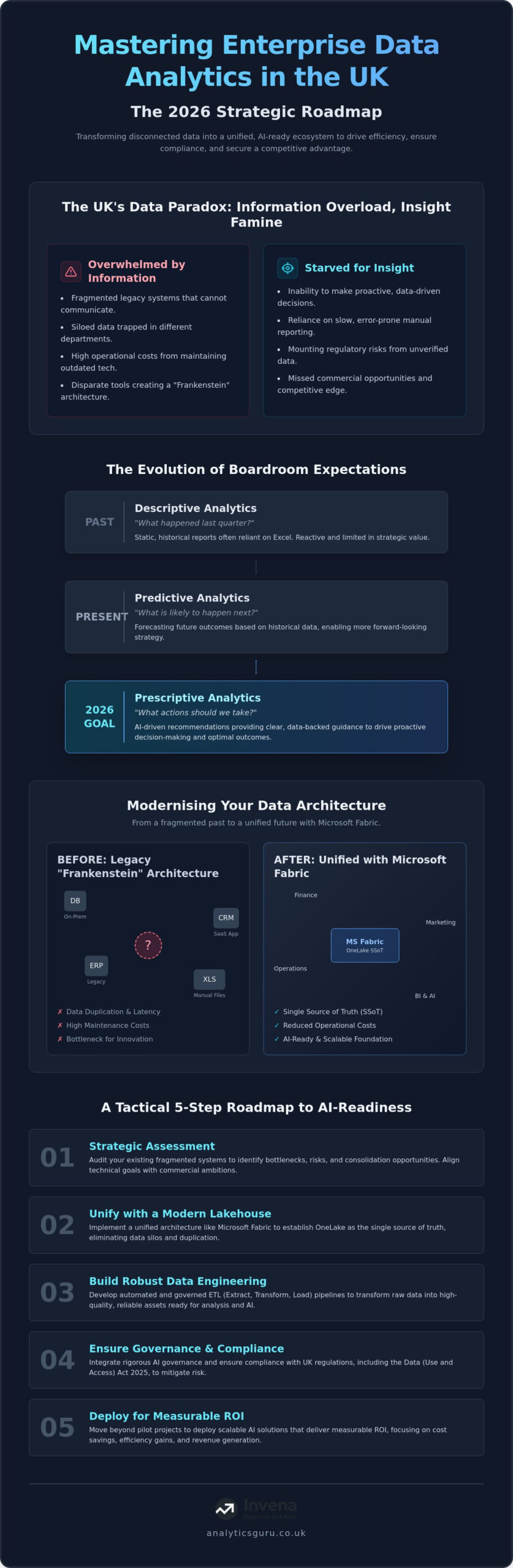
Enterprise data analytics UK has matured into a sophisticated synthesis of high-level engineering, strategic Business intelligence, and production-grade AI. It’s no longer enough to treat these as separate departments. Modern leaders recognise that a fragmented approach leads to the “Data Paradox,” where you’re drowning in information but starving for direction. In 2026, the focus has shifted from merely collecting data to refining it into a strategic asset that powers every executive decision.
British boardrooms have undergone a fundamental shift in their expectations. The era of descriptive analytics, which simply explained what happened last quarter, is over. Today’s competitive landscape demands predictive and prescriptive capabilities. You need to know what’s likely to happen next and receive clear, data-backed recommendations on how to respond. This transition is essential for maintaining a competitive edge in a market that moves at the speed of real-time feeds. Relying on fragmented Excel-based reporting is a liability that slows down your response time and introduces unnecessary risk.
This year also marks the definitive end of the “experimental AI” phase for UK organisations. The novelty of standalone pilot projects has worn off, replaced by a demand for scalable, governed systems that deliver measurable ROI. With the Data (Use and Access) Act 2025 now fully integrated into corporate governance, businesses can’t afford the risks associated with “shadow AI” or unverified data sources. Modernisation isn’t a choice; it’s a regulatory and commercial necessity that requires a unified cloud architecture.
The Shift Towards Unified Data Ecosystems
We’re seeing a rapid transition from traditional, rigid data warehouses to modern Lakehouse architectures. These systems combine the structure of a warehouse with the flexibility of a data lake, allowing for the seamless processing of both structured and unstructured information. Real-time data processing has become a prerequisite for success amongst UK peers, enabling instant responses to market fluctuations. Unified data ensures every department operates from the same governed dataset without technical barriers or information silos.
Why UK Enterprises are Modernising Now
The financial burden of maintaining legacy on-premise infrastructure has reached a tipping point for those investing in enterprise data analytics UK. These ageing systems are not only expensive to run but also act as a bottleneck for innovation. In the 2026 economic climate, efficiency is the primary driver of growth. Leaders now demand actionable insights that lead directly to cost savings or revenue generation, rather than static reports that require manual interpretation. Modern cloud architectures provide the agility needed to pivot quickly whilst keeping operational costs under control.
Modern Architecture: Moving Beyond Fragmented Data Silos to Microsoft Fabric
Many UK organisations currently operate on a “Frankenstein” architecture. This patchwork of disconnected tools and disparate data sources creates friction, increases latency, and inflates operational costs. Microsoft Fabric solves this by providing a unified, all-in-one analytics environment designed for the modern enterprise. At its core is OneLake, which functions as a single, logical data lake for the entire organisation. It eliminates the need for data duplication, allowing your teams to access a single version of the truth without moving or copying files across various platforms. This level of integration is essential for mastering enterprise data analytics UK in a competitive market.
The Role of Data Engineering in Transformation
Successful AI implementation depends entirely on the quality of the underlying data engineering. You cannot skip the engineering layer and expect reliable results. Robust ETL (Extract, Transform, Load) pipelines are the engine room of your data strategy. They transform raw, unlabelled data into high-quality, governed assets. For UK financial reporting, automation is a necessity rather than a luxury. It removes the risk of human error and ensures your reports meet the strict standards of the 2026 regulatory environment. The official data skills gap report highlights the scarcity of talent capable of building these sophisticated systems. If your internal team is stretched, our Data Engineering & Fabric Services provide the steady hand needed to architect these critical pipelines.
Power BI: The Visualisation Layer for Strategic Decision-Making
Power BI acts as the visualisation layer that brings your Fabric architecture to life. It translates complex engineering outputs into real-time dashboards that drive immediate action. For UK management teams, custom KPI dashboards allow for the monitoring of performance against local market conditions. Moving away from legacy Tableau environments or manual Excel workbooks to a unified Power BI setup simplifies your software stack. This migration doesn’t just save on licensing costs; it empowers your leaders to make decisions based on live, accurate data rather than historical snapshots. By consolidating your reporting within the Microsoft ecosystem, you ensure that every stakeholder sees the same version of the truth.
Navigating the UK Regulatory and Operational Data Challenges
UK boardrooms are currently wrestling with the Data (Use and Access) Act 2025, which introduced significant shifts in how we handle automated decision-making and data subject access requests (DSARs). This legislation creates a “UK Data Paradox.” Companies want to leverage vast datasets for AI training, yet they must maintain absolute transparency and privacy under the updated UK GDPR. Successfully implementing enterprise data analytics UK in this environment requires a delicate balance. You must ensure your architecture is open enough for innovation but resilient enough to withstand rigorous regulatory scrutiny, especially with the new formal data protection complaints procedure required from June 2026.
Many organisations find themselves stalled by a widening skills gap that threatens to derail modernisation efforts. The complexity of migrating legacy systems whilst maintaining compliance often exceeds the capacity of internal IT teams. This is where engaging specialist business intelligence consulting UK expertise becomes a strategic necessity. We help you bridge the gap between boardroom ambition and engineering reality, ensuring your transformation projects don’t just start, but finish with measurable success. Partnering with experts allows your business to bypass common pitfalls and accelerate the delivery of actionable intelligence.
UK GDPR and AI Governance in 2026
The 2026 landscape demands strict adherence to data residency and sovereignty. UK firms must ensure sensitive information remains within local jurisdictions to satisfy sector-specific mandates, particularly in finance and healthcare. Ethical AI governance is no longer optional. You need clear audit trails for every automated decision your system makes, as dictated by Articles 22A to 22D of the amended UK GDPR. Microsoft Azure provides the necessary security foundation, offering robust encryption and compliance tools that align perfectly with these local standards. This infrastructure allows you to scale without compromising your legal standing.
Overcoming Internal Resistance to Data Transformation
Technical hurdles are often secondary to cultural ones. Internal resistance usually stems from a fear of the unknown or a perceived threat to job security. Overcoming this requires a shift in narrative. Modernisation should be framed as an empowerment tool that removes the drudgery of manual data entry and lets staff focus on high-value strategy. Comprehensive training and support are vital here. When your team understands how to use these new tools to achieve their own KPIs, adoption becomes a natural byproduct of increased efficiency. We focus on delivering tailored support that builds confidence across your entire workforce, ensuring your investment pays dividends through long-term tool usage.
Building the AI-Ready Foundation: A Tactical Roadmap for Senior Leaders
Achieving true AI-readiness is an engineering challenge, not a software acquisition. Many British organisations rush into AI pilots only to find their models are built on unstable, siloed data. This leads to inaccurate outputs and wasted investment. To succeed in enterprise data analytics UK, you must prioritise the engineering layer before attempting to deploy sophisticated machine learning models. A robust foundation ensures your data is governed, clean, and accessible across the entire organisation.
This tactical roadmap provides a structured path from legacy fragmentation to a unified, high-performance architecture. It moves beyond the hype of “rapid AI” to focus on the concrete steps required for long-term stability. By following this sequence, you ensure that every pound spent on modernisation contributes directly to measurable business growth.
Step 1: Data Audit and Strategy Alignment
The first step involves a comprehensive audit of your existing data sources to identify hidden silos and redundant systems. You must define how your data goals align with specific UK business objectives, such as reducing operational costs or accelerating market expansion. We look for where the “Data Paradox” is most prevalent: areas where you have high volumes of data but zero actionable insight. A successful data audit results in a clear lineage map that identifies every critical data asset and its commercial value.
Step 2: Engineering the Unified Data Lake
Once you have a strategy, the technical migration begins. This typically involves moving from ageing on-premise servers to a modern Lakehouse architecture within Microsoft Fabric or Azure. During this phase, we implement rigorous “cleansing” protocols to ensure that only high-quality, verified data enters your new ecosystem. Automation plays a vital role here; it maintains data integrity during the migration process and prevents the re-introduction of legacy errors. If you’re ready to begin this transition, our Data Engineering & Fabric Services can help you architect a foundation that is built for the demands of 2026.
The Discovery phase follows, where we pinpoint exactly where your most valuable intelligence sits. This allows your team to focus their efforts on the data that drives the highest ROI. From here, we move into the Prototype phase. We build a Minimum Viable Product (MVP) dashboard that demonstrates the power of the new system to your stakeholders, proving the concept before a full rollout. Finally, the Scale phase involves deploying this unified analytics capability across the entire organisation. This ensures every department, from finance to operations, makes decisions based on a single, real-time source of truth. For a deeper understanding of how this process works in practice, our guide on turning raw data into insights provides a complementary framework for building automated reporting pipelines that deliver consistent, actionable intelligence.
Partnering for Performance: How Analytics Guru Drives Enterprise Value
Navigating the complexities of enterprise data analytics UK requires more than just technical proficiency; it demands a partner who understands the high-stakes environment of British industry. Analytics Guru serves as that strategic partner, bridging the gap between high-level boardroom objectives and the granular reality of the engineering lab. With over 20 years of experience, we act as a steady hand for organisations undertaking complex digital transformations. We don’t just implement tools. We build the systems that drive sustainable growth.
Our approach combines sophisticated strategy with deep technical engineering. This dual focus ensures that your data architecture is not only technically sound but also commercially relevant. A 99%+ customer retention rate reflects our commitment to long-term success and our ability to deliver consistent results. Whilst large global consultancies often provide generic, one-size-fits-all solutions, we offer a specialised, boutique service that prioritises your specific operational needs and long-term stability.
End-to-End Delivery: From Integration to Insights
We manage the entire lifecycle of your data transformation. Our team handles everything from the initial Microsoft Fabric Data Engineering to the creation of bespoke Power BI dashboards that provide real-time clarity. We recognise that technology alone isn’t enough to change an organisation. That’s why we include managed support and comprehensive training services. These ensure your staff are fully equipped to utilise new systems, turning your technical investment into a cultural shift towards data-driven decision-making.
Taking the Next Step in Your Data Journey
Modernising your enterprise data architecture is a significant undertaking that requires a clear starting point. We invite you to schedule a Discovery Call to assess the current state of your systems and identify the most immediate opportunities for improvement. Our focus remains firmly on tangible business impact. We aim to help you achieve faster growth, reduced operational costs, and smarter, more confident decisions across every department. Don’t let fragmented legacy systems hold your business back in a rapidly evolving market.
Consult with an Analytics Guru expert to modernise your UK enterprise data
Securing Your Competitive Advantage Through Data Maturity
Modernising your approach to enterprise data analytics UK is no longer a luxury; it’s a fundamental requirement for commercial survival. We’ve explored how transitioning from fragmented silos to a unified Microsoft Fabric architecture creates a single source of truth whilst ensuring compliance with the Data (Use and Access) Act 2025. By prioritising a robust engineering foundation, you eliminate the data paradox and prepare your organisation for scalable, high-impact AI implementation. Success in 2026 depends on your ability to turn raw information into a precise strategic asset that informs every boardroom decision.
With over 100 successful data projects completed and a 99%+ customer retention rate, we offer the specialised UK expertise in Microsoft Fabric and Power BI needed to navigate this complex transition safely. Partner with Analytics Guru to transform your enterprise data strategy and secure your firm’s competitive advantage. Your journey from legacy fragmentation to a unified, AI-ready architecture starts with a single, decisive step.
Frequently Asked Questions
What is the current state of enterprise data analytics in the UK for 2026?
The 2026 landscape is defined by a decisive shift from experimental AI pilots to governed, production-ready systems. UK enterprises are rapidly moving away from fragmented legacy architectures to comply with the Data (Use and Access) Act 2025. This transition ensures that enterprise data analytics UK becomes a driver of measurable growth rather than a source of regulatory anxiety. Businesses now prioritise a single source of truth over disconnected reporting silos.
How does Microsoft Fabric simplify enterprise data management?
Microsoft Fabric simplifies management by consolidating disparate tools into a single, logical data lake known as OneLake. It removes the need for complex data movement and duplication across your organisation. This unified environment integrates data engineering, warehousing, and BI capabilities, allowing your teams to work from the same governed dataset. It essentially eliminates the technical friction typically associated with managing a multi-vendor analytics stack.
Why is data engineering more important than AI for most UK businesses?
Data engineering provides the essential foundation that makes AI outputs reliable and actionable. Without robust ETL pipelines and cleansed datasets, AI models often produce inaccurate predictions that lead to poor commercial decisions. Most UK businesses find that fixing their engineering layer delivers immediate efficiency gains. It ensures that any subsequent AI investment is built on a stable, governed, and high-quality infrastructure.
How long does a typical enterprise data modernisation project take?
Timelines vary depending on the complexity of your legacy estate, but a phased modernisation usually takes between three and nine months. We start with a Discovery phase to audit assets, followed by a Prototype phase to build an MVP dashboard. This approach allows you to see tangible value within weeks whilst the full organisation-wide scale-up continues. A structured roadmap prevents the project from becoming an endless technical exercise.
What are the main risks of migrating legacy data to the cloud?
The primary risks include data integrity loss during the migration process and security vulnerabilities caused by misconfigured cloud environments. Legacy systems often contain unlabelled or corrupted data that requires significant cleansing before it is fit for the cloud. Failing to account for these factors can lead to operational downtime or compliance breaches. A steady hand consultancy mitigates these risks through automated validation and rigorous testing protocols.
How can UK organisations ensure compliance with GDPR whilst using AI analytics?
Compliance is achieved by maintaining clear audit trails and ensuring data residency within UK-based Azure regions. The Data (Use and Access) Act 2025 requires transparency in automated decision-making, so your AI models must be explainable and governed. By using Microsoft Fabric’s built-in security features, you can enforce strict access controls. This ensures that sensitive personal information is protected whilst still being accessible for strategic enterprise data analytics UK.
What is the ROI of investing in a unified data platform?
ROI is realised through the reduction of operational costs and the acceleration of strategic decision-making. By consolidating your software stack, you eliminate redundant licensing fees and reduce the manual labour required for data preparation. Faster access to accurate insights allows you to identify market opportunities and inefficiencies ahead of your peers. A unified platform turns data from an expensive cost centre into a profit-driving asset.
How do custom Power BI dashboards improve executive decision-making?
Custom Power BI dashboards translate complex engineering data into clear, visual KPIs that demand immediate action. They move your leadership team away from historical reporting and towards predictive insights. This real-time visibility allows executives to pivot strategy based on live market conditions rather than outdated monthly snapshots. Consolidating your reporting in Power BI ensures every stakeholder is aligned with the same commercial truth.