



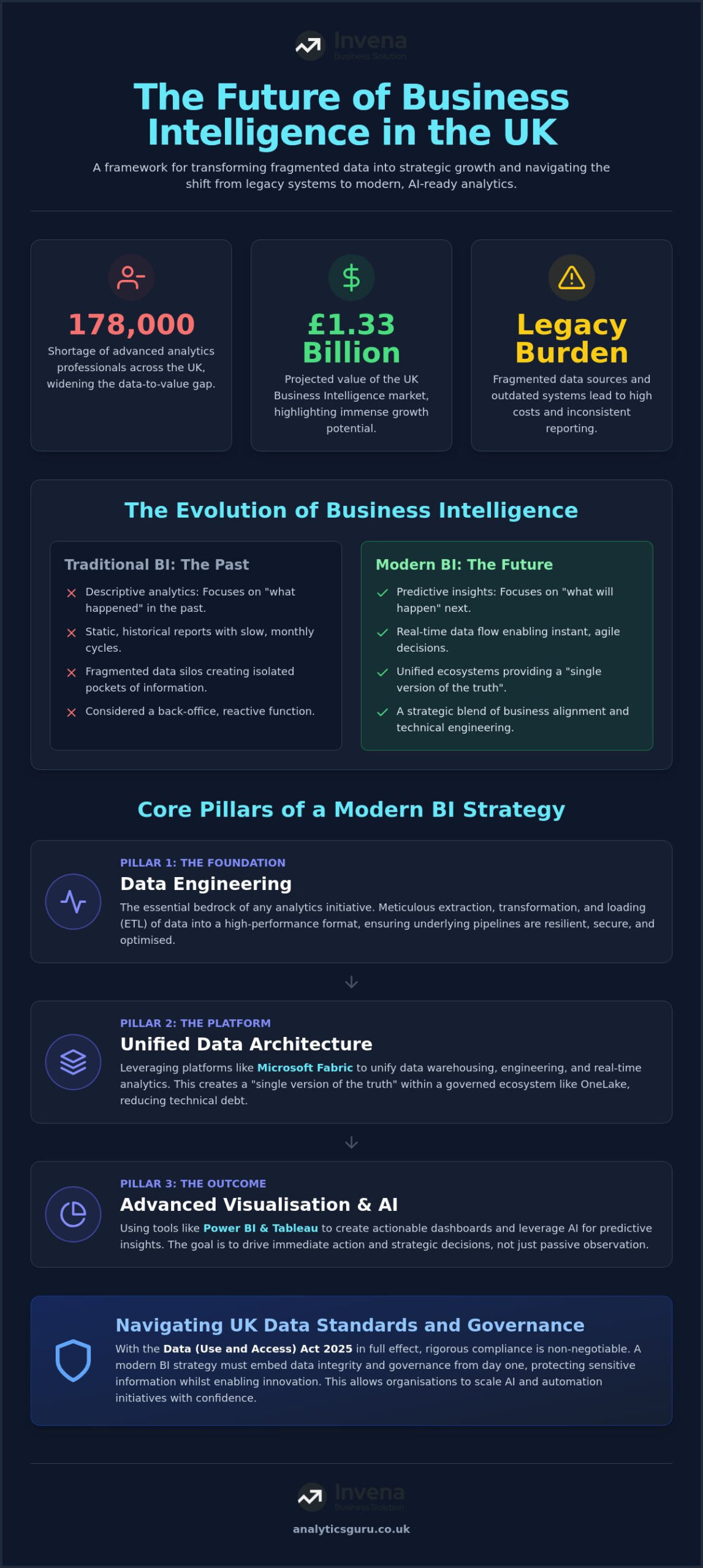
With a projected shortage of 178,000 advanced analytics professionals across the country, the gap between collecting data and generating actual value has never been wider. Most UK decision-makers recognise that their legacy systems are struggling to keep pace, yet they lack the internal capacity to migrate to modern platforms like Microsoft Fabric. This is why business intelligence consulting UK services have become essential for firms aiming to maintain a competitive edge in a market now valued at over £1.33 billion.
It’s difficult to lead effectively when fragmented data sources produce inconsistent reports and drain your budget through high maintenance costs. You deserve a data ecosystem that doesn’t just store information but actively accelerates executive decision-making. This guide delivers a comprehensive framework to help you navigate modern BI architectures, select a strategic consulting partner, and transform raw data into measurable growth. We will examine how to establish a unified “single version of the truth” whilst building a scalable architecture that is fully compliant with the Data (Use and Access) Act 2025 and ready for the next wave of AI automation.
Key Takeaways
- Move beyond static reporting by adopting a predictive BI strategy that prioritises organisational agility and strategic data architecture.
- Explore the technical foundations of modern analytics, focusing on how Microsoft Fabric integrates fragmented sources into a unified “single version of the truth”.
- Evaluate the long-term ROI of partnering with specialist business intelligence consulting UK firms to avoid the high costs and expertise shortages associated with in-house development.
- Implement a robust framework for selecting a consultancy that offers deep technical expertise and a proven track record within the UK regulatory landscape.
- Transform raw data into strategic growth by leveraging an end-to-end delivery model that scales from engineering to AI-driven insights.
The Evolution of Business Intelligence Consulting in the UK
The UK market has reached a critical tipping point where traditional data handling no longer supports the pace of modern commerce. Historically, Business intelligence (BI) was viewed as a back-office function responsible for generating static reports that arrived weeks after the events they described. Today, the focus has shifted entirely toward strategic data architecture. UK organisations are moving away from fragmented point solutions that create isolated pockets of information. They now require integrated ecosystems that provide a single, reliable source of truth across the entire enterprise.
This shift represents a move from descriptive analytics to predictive insights. It isn’t enough to understand what happened last quarter; executive teams now demand to know what will happen next month. Effective business intelligence consulting UK identifies these needs early, building the technical foundations required to anticipate market shifts rather than just reacting to them. Modern BI consulting is a blend of technical engineering and strategic business alignment.
From Static Dashboards to Real-Time Ecosystems
Monthly reporting cycles have become a liability for competitive UK enterprises. In an environment where the UK BI market is expected to reach £1.33 billion by the end of 2026, operational agility is the primary differentiator. Real-time data flow allows managers to adjust supply chains, marketing spend, or staffing levels instantly. Consultancies now play a vital role in bridging the gap between legacy data silos and modern cloud platforms. They don’t just build dashboards; they engineer the pipelines that ensure data is fresh, accurate, and accessible the moment it’s needed. This transition removes the friction that typically slows down large-scale organisations.
The Impact of UK Data Standards and Governance
The regulatory landscape in the United Kingdom has become significantly more complex. With the Data (Use and Access) Act 2025 now in full effect, businesses must maintain rigorous compliance whilst simultaneously driving innovation. This creates a delicate balance. A seasoned consultant ensures that data integrity is baked into the architecture from day one. They implement governance frameworks that protect sensitive information without stifling the flow of insights. By aligning technical capabilities with UK-specific legal requirements, consultancies provide a steady hand that allows firms to scale their AI and automation initiatives with confidence. You can’t achieve true digital transformation if your underlying data remains unorganised or non-compliant.
Core Pillars of a Modern BI Strategy: Engineering to AI
Any high-impact analytics initiative begins long before a dashboard appears. Data engineering serves as the essential bedrock. It involves the meticulous extraction, transformation, and loading of information from disparate sources into a high-performance, structured format. Without robust engineering, your reports remain unreliable, slow, and prone to error. Expert business intelligence consulting UK ensures these underlying pipelines are resilient, secure, and fully optimised for high-speed processing. This foundation allows for the seamless flow of information across the entire organisation.
Microsoft Fabric and Unified Data Architecture
Microsoft Fabric has redefined how UK enterprises manage their data stacks in 2026. By unifying data warehousing, data engineering, and real-time analytics into a single environment, it removes the friction of managing fragmented systems. You no longer need to juggle separate providers for data lakes and SQL warehouses. Instead, everything resides within OneLake; a governed ecosystem that reduces technical debt whilst accelerating your time-to-insight. This unified approach allows your team to focus on strategic growth rather than constant infrastructure maintenance. It’s the most efficient way to achieve a single version of the truth in a complex digital environment.
Advanced Visualisation with Power BI and Tableau
Modern visualisation must drive immediate action rather than passive observation. Effective dashboards distinguish between executive-level strategic overviews and operational-level tactical details. Whilst a Director might monitor regional market share, a logistics manager needs real-time visibility into fleet efficiency and fuel costs. By utilising platforms like Power BI or Tableau, organisations can deploy mobile-first interfaces that empower decision-makers regardless of their location. This ensures that critical insights are accessible at the exact moment they are needed. High-quality visualisations translate complex datasets into intuitive narratives that anyone in the business can understand and act upon.
The final pillar involves embedding AI and predictive analytics to secure long-term growth. In 2026, generative AI assistants are integrated directly into the BI workflow, allowing staff to query complex datasets using natural language. These tools don’t just describe the past; they forecast future demand with precision, helping UK firms allocate resources more effectively. If your organisation struggles to bridge the gap between raw data and these advanced capabilities, it’s worth considering expert BI implementation to modernise your architecture. This transition from descriptive to predictive analytics is what ultimately separates market leaders from their competitors in the British market.
Evaluating the ROI: Why UK Enterprises Partner with Specialists
Attempting to build a modern analytics platform using only internal resources often leads to a cycle of high costs and diminishing returns. Whilst the initial “DIY” approach seems cost-effective, UK firms frequently encounter the “data swamp” phenomenon; a state where data is abundant but entirely unusable due to poor structural foundations. Choosing professional business intelligence consulting UK services provides a shortcut to maturity. It allows your organisation to bypass common architectural pitfalls and focus immediately on generating value. Specialist consultants bring proven methodologies that accelerate time-to-insight, ensuring your investment delivers measurable growth rather than mounting technical debt.
In-house Development vs. Specialist Consultancy
The primary hurdle for most British businesses is the current analytics talent gap. With an estimated shortage of 178,000 workers with advanced data skills in the UK, recruiting a full-scale internal team is both slow and prohibitively expensive. External specialists bridge this gap instantly. They provide an “outside-in” perspective that identifies hidden opportunities within your data that internal teams might overlook due to operational tunnel vision. This partnership model ensures that your projects move from the engineering phase to executive dashboards in weeks, not months. You gain access to a “steady hand” that has navigated similar migrations dozens of times, significantly reducing the likelihood of project failure.
Quantifying Business Impact and Growth
Measuring the success of a BI initiative requires looking beyond technical milestones to actual business outcomes. Automated reporting alone can save thousands of man-hours across an organisation by eliminating the need for manual data preparation in Excel. This efficiency allows your most expensive assets; your people; to focus on strategy rather than administration. When implemented correctly, specialist BI consulting reduces data migration risks by as much as 40% through the use of pre-built frameworks and automated testing protocols. These improvements translate directly into operational efficiency and improved revenue growth. For a deeper understanding of how to structure this process effectively, our guide on turning raw data into insights for UK enterprises provides a practical framework for replacing labour-intensive processes with automated, unified reporting pipelines.
Building for 2026 requires an architecture that scales with your ambition. A specialist partner ensures that your data environment is not just functional today but ready for the integration of advanced AI and automation tomorrow. By establishing a robust, governed foundation now, you avoid the future costs of tearing down and rebuilding legacy systems that cannot support modern workloads. This forward-thinking approach protects your capital and ensures your organisation remains agile in an increasingly data-dependent UK market. Organisations looking to extend this agility beyond analytics should also explore business process automation UK strategies to eliminate manual workflows and scale operations without a proportional increase in headcount.
Selecting Your Consultancy: A Framework for UK Decision-Makers
Selecting a partner for business intelligence consulting UK is a high-stakes decision that dictates your organisation’s analytical maturity for years. It requires moving past polished sales presentations to scrutinise actual delivery capabilities and strategic alignment. A successful partnership hinges on the consultancy’s ability to translate complex technical requirements into clear business outcomes whilst maintaining operational stability. You need a “steady hand” that understands the specific nuances of the British regulatory environment and the commercial pressures unique to your industry.
Five Essential Questions for Your Potential BI Partner
Before signing a contract, use these targeted questions to evaluate a consultancy’s practical expertise:
- How do you handle legacy data integration without disrupting our current operations? Look for a clear methodology that prioritises data availability and minimises downtime during the transition.
- What is your approach to data governance and security under the Data (Use and Access) Act 2025? Ensure they have a deep understanding of current UK compliance requirements and how to bake these into the architecture.
- Can you demonstrate a clear ROI from a similar UK enterprise project? A reliable partner should provide case studies that show measurable improvements in efficiency or revenue, not just technical milestones.
- How do you ensure our data architecture is ready for future AI integration? The architecture must be scalable and structured to support generative AI and automated decision-making.
- What does your post-implementation support and training look like? Long-term adoption fails without a structured plan to empower your internal team.
Vetting Technical Proficiency in Microsoft Fabric and Power BI
Certifications are the baseline for any reputable firm, but project history serves as the ultimate proof of proficiency. When evaluating technical depth, ask for evidence of complex Microsoft Fabric implementations that unify disparate data streams into a single, governed environment. The consultancy should demonstrate how they have used Power BI to create intuitive narratives that drive action at every level of an organisation. Their delivery model must be transparent and milestone-based, providing you with full visibility into the project’s progress and budget consumption.
True value lies in a partner’s ability to leave your team stronger than they found it. A specialist business intelligence consulting UK firm doesn’t just build a solution and walk away; they provide the training and support services necessary for long-term self-sufficiency. This ensures that your investment continues to pay dividends as your business evolves and your data needs grow more complex. If you’re ready to move beyond fragmented reporting and build a unified, AI-ready ecosystem, book a strategic consultation with our senior engineering team to discuss your roadmap.
Transforming Data into Strategy with Analytics Guru
Analytics Guru brings two decades of technical precision to the British market, providing the steady hand required to navigate the complexities of modern data transformation. With 20 years of experience in the business intelligence consulting UK sector, we have refined an end-to-end delivery model that bridges the gap between raw engineering and executive-level strategy. We don’t just act as a vendor; we function as a long-term strategic partner, prioritising your organisation’s stability and growth over simple technical completion. Our focus remains on distilling complexity into clarity, ensuring that every data pipeline we build contributes directly to your commercial success.
The Analytics Guru Methodology
We specialise in organising complex, fragmented datasets into streamlined business assets that empower every level of your firm. By leveraging the unified power of Microsoft Fabric and the intuitive storytelling of Power BI, we create modernised workflows that remove operational friction. Our team has successfully delivered over 100 projects, helping global enterprise clients and UK-based organisations move from descriptive reporting to predictive growth. We understand that a successful BI programme requires more than just code. It demands a deep alignment with your specific objectives, ensuring that your technical infrastructure supports your long-term vision whilst remaining agile enough to adapt to market shifts.
Get Started with a Strategic Data Audit
The path to a unified data architecture begins with a clear understanding of your current limitations. Our strategic data audit is designed to identify immediate bottlenecks, security gaps, and untapped growth opportunities within your existing stack. We provide a concrete roadmap that outlines how to transition toward a scalable, AI-ready environment without disrupting your daily operations. This process is a cornerstone of effective business intelligence consulting UK, moving you away from reactive troubleshooting toward a proactive, insight-driven culture.
Beyond the initial implementation, we offer bespoke training and managed support services to ensure your team remains self-sufficient. We believe that true digital transformation is only achieved when your staff feels empowered to use these tools effectively. If you are ready to eliminate inconsistent reporting and high maintenance costs, now is the time to secure your competitive position for 2026. Book a Strategic BI Consultation with Analytics Guru today to begin your roadmap toward data-driven excellence.
Securing Your Competitive Advantage for 2026
Modernising your data stack is no longer a luxury; it’s a strategic necessity for firms aiming to lead in an increasingly automated market. Transitioning from reactive, descriptive reporting to a proactive, predictive model requires a unified architecture that eliminates silos. By adopting platforms like Microsoft Fabric, you establish a “single version of the truth” that supports faster executive decision-making and remains fully compliant with evolving British regulations. Expert business intelligence consulting UK ensures this transition is seamless, efficient, and aligned with your long-term commercial goals.
Analytics Guru provides a steady hand for these complex transformations. With over 20 years of consulting excellence and a 99%+ customer retention rate, we specialise in end-to-end Microsoft Fabric and Power BI implementations. Our focus remains on delivering tangible business value whilst removing the technical obstacles that hinder growth. You don’t have to navigate the talent gap alone. Book your strategic BI consultation today to audit your current environment and build an AI-ready roadmap. Your data holds the key to future expansion; we help you unlock it.
Frequently Asked Questions
What is the difference between a BI consultant and a data analyst?
A BI consultant focuses on the high-level strategy and technical architecture required to transform your data landscape, whilst a data analyst typically works within those systems to interpret specific datasets. The consultant builds the resilient pipelines and governed environments that allow analysts to function effectively. Essentially, the consultant provides the “steady hand” to engineer the platform, and the analyst uses it to answer daily business questions.
How long does a typical Business Intelligence implementation take in the UK?
A standard initial phase for business intelligence consulting UK projects usually spans between eight and twelve weeks. This period includes the discovery phase, data engineering, and the deployment of your first set of automated dashboards. More complex enterprise-wide transformations that involve migrating extensive legacy systems can take six months or more to reach full operational maturity across all departments.
Why should our UK organisation move to Microsoft Fabric in 2026?
Microsoft Fabric unifies your entire data stack into a single, governed environment called OneLake, which significantly reduces the cost of maintaining fragmented legacy systems. In 2026, this platform serves as the foundation for UK businesses seeking to integrate generative AI and real-time analytics. It removes the friction of managing separate data lakes and warehouses, allowing your organisation to accelerate its time-to-insight.
Can a BI consultancy help with legacy data migration from Excel?
Yes, a specialist consultancy can migrate fragmented Excel-based reporting into a centralised, automated database. This process eliminates manual data entry errors and ensures that every department is working from the same validated figures. By automating these pipelines, your team saves hundreds of man-hours previously spent on spreadsheet maintenance, allowing them to focus instead on high-level strategic growth initiatives.
What are the ongoing costs of hiring a BI consulting firm?
Ongoing costs typically involve software licensing fees and managed support services to ensure your system remains optimised as your data volume grows. Many organisations also invest in periodic training to keep their internal teams updated on the latest platform features. Whilst business intelligence consulting UK requires an initial investment, it prevents the much higher long-term costs associated with project failure and unmanaged technical debt.
How does BI consulting support data-driven decision-making at the executive level?
BI consulting establishes a “single version of the truth” that allows executives to make decisions based on real-time facts rather than intuition. By implementing predictive analytics, leaders can anticipate market shifts and allocate resources with greater precision. This clarity reduces the risk of strategic errors and ensures the organisation remains agile and competitive within the British commercial landscape.
Do you provide training for our internal team after the BI project is finished?
Structured training is a vital component of our delivery model to ensure long-term project success and self-sufficiency. We empower your internal staff to manage dashboards and perform their own analysis, which reduces your reliance on external support for daily tasks. This knowledge transfer is essential for fostering a data-driven culture and maximising the return on your technical investment.
How do you ensure data security and GDPR compliance during a BI project?
We implement rigorous governance frameworks that align with the Data (Use and Access) Act 2025 and UK GDPR requirements. This includes end-to-end encryption, role-based access controls, and automated data masking for sensitive information. By building security into the architecture from day one, we ensure your organisation drives innovation whilst maintaining full regulatory compliance and protecting stakeholder trust.